
The Self in Recursive Self-Improvement Has To Be Human | Stay Human 12, 13 | Artificiality Summit Speaker profile: Ricky Bloomfield
The Self in Recursive Self-Improvement Has To Be Human It's been a week. On Tuesday the Australian
The Self in Recursive Self-Improvement Has To Be Human It's been a week. On Tuesday the Australian

The machine can compute any choice but it cannot live with one. This chapter is about the ones you have to live with.
Engineers say test it and ship it, or shut the lab down. Others imply everything will emerge from a society of agents. Both are partly right, but I think both make a deep error, and it's one that matters for designing Minds for Our Minds.
Every exponential in history has reorganized the system it entered—and the thing that becomes scarce is never what the curve predicted. This time, it's the capacity to know whether any of the abundant, coherent, AI-generated output is actually true.

If you're worried about agents taking over the world—and your job—Demis Hassabis said something recently that seems overdue. He described watching young developers run dozens of AI agents simultaneously, producing enormous volumes of functional code. Across all of that output, he had yet to see a single genuinely new product emerge.
"I often wonder I see a lot of people working on... setting off, you know, dozens of agents for like 40 hours, but I'm not sure I've seen the output yet of that quite justify that level of input going in."—Demis Hassabis
Anyone using agents seriously probably recognizes this immediately. The systems are remarkable, occasionally intoxicating, and capable of generating work at massive scale. But Hassabis is talking about something beyond a temporary productivity gap. When production becomes effectively unconstrained, value stops tracking output in the way we expect.
That may turn out to be one of the defining economic shifts of the AI era.
To understand why, we need to zoom out. AI is not entering a stable economic system. It is arriving inside a civilization already operating under multiple overlapping exponentials.
Beginning around 1950, scientists documented what is now called the Great Acceleration. Two dozen indicators of human activity—GDP, population, energy use, water consumption, fertiliser, carbon emissions, telecommunications—all went exponential within roughly a decade of each other. Globally, hundreds of millions lifted from poverty, life expectancy up dramatically, and material progress happened at a scale difficult to imagine a century earlier.
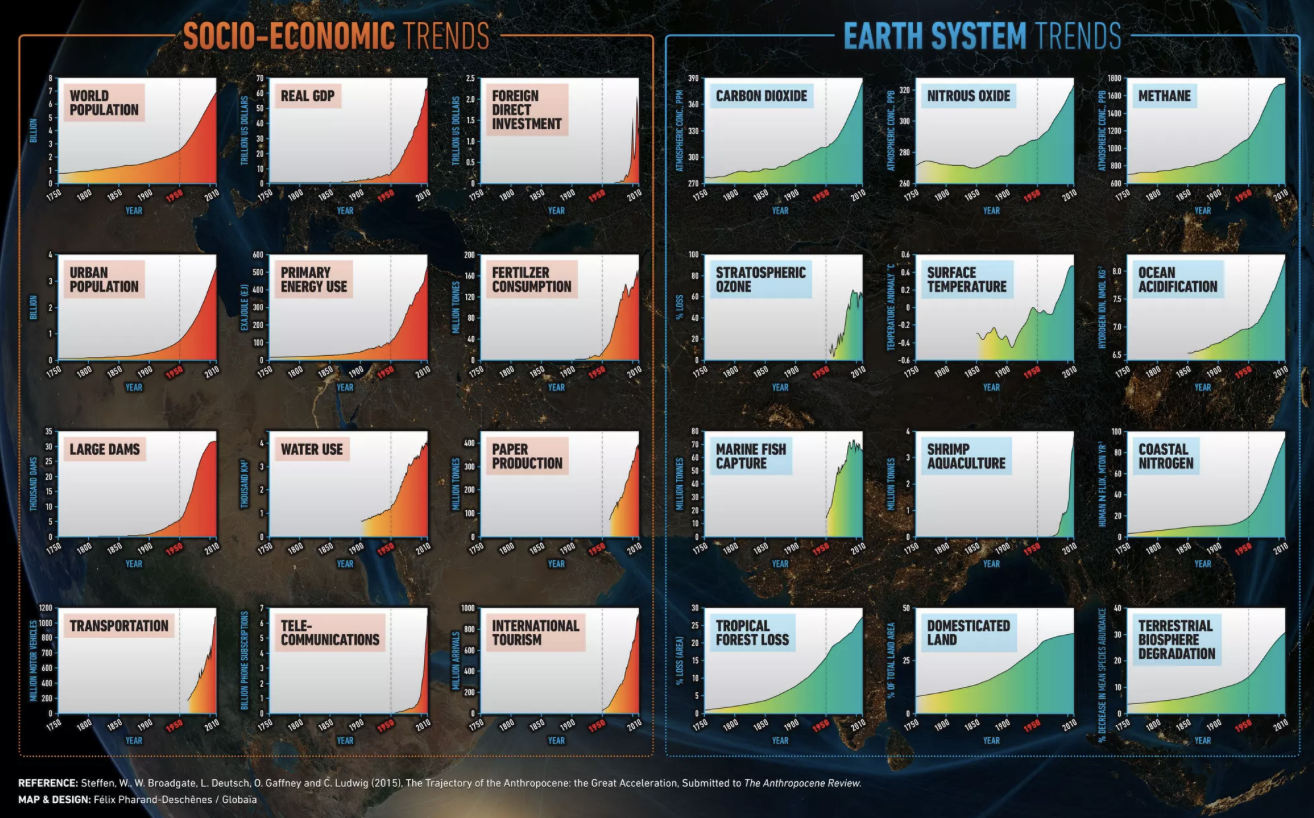
Seventy-five years later these curves are still running and the accumulated consequences are now visible. GDP growth has decoupled from wellbeing and energy use correlates increasingly with environmental degradation. The metrics that tracked progress in 1955 measured something qualitatively different in 2025. We can now see how the relationship between the curves and their meaning has changed.
AI arrives into this already-exponential system. It is an exponential technology landing on top of existing exponentials that have already pushed past the point where proportional relationships between inputs and outcomes hold. What happens when you stack exponentials in a complex system already exhibiting signs of state change?
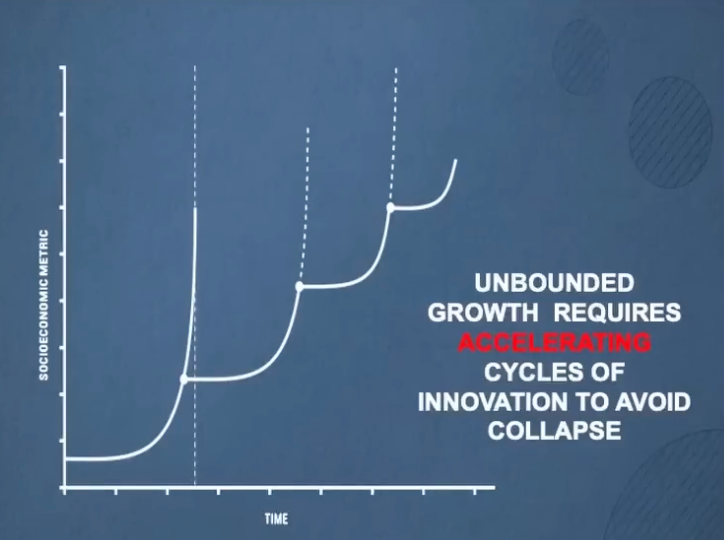
One way I like to think about this comes from complexity science—specifically, Geoffrey West's work on phase changes in economies. West has shown that complex systems under exponential pressure don't just keep scaling—they hit a ceiling and reorganize onto a new curve. Each cycle of innovation buys another stretch of growth, but the cycles have to come faster each time. The intervals between jumps compress. And at each jump, the system reorganizes—new scarcities, new rules, new structures.
And this brings me to the proposition that we are heading toward 'post-scarcity.' If you aren't familiar with it, it's the idea that AI will make production so cheap and abundant that economic scarcity itself—the fundamental condition of not having enough—simply disappears.
I find this argument strange precisely because it relies on the same exponential logic that undermines it. The entire point of exponentials in complex systems is that they stop producing proportional outcomes. The relationships between inputs and outputs begin to destabilize. Transfer functions break. Systems reorganize. And yet the post-scarcity story takes an exponential capability curve and extends it forward as though the surrounding system remains stable: intelligence goes up, therefore abundance follows.
But that is not how complex systems behave under acceleration.
West’s work points in almost the opposite direction. As exponential systems scale, they do not smoothly continue along the same curve. They encounter constraints, instability, and eventually phase transition. The system reorganizes onto a different curve with different scarcities, different bottlenecks, and different structural demands. Each innovation cycle temporarily resolves the pressures created by the previous one, but the intervals between those cycles compress. The jumps have to come faster and faster simply to stay stable.
And critically, there is nothing in the mathematics that says the next jump must be upward. If innovation fails to arrive quickly enough—or if institutions cannot absorb the transition—the system does not plateau peacefully. It destabilizes. Sometimes violently.
This matters because AI is arriving inside systems that are already exhibiting signs of strain from seventy-five years of stacked exponentials. We are not introducing acceleration into equilibrium but rather into systems already struggling to metabolize the consequences of previous acceleration.
Which means the question is probably not whether AI eliminates scarcity but where scarcity moves next. Historically, scarcity does not disappear under technological acceleration. Instead, what is scarce changes. This does not mean AI cannot produce extraordinary abundance in some domains. It almost certainly will. But abundance in one layer of a complex system does not eliminate constraint from the system itself. It reorganizes where the constraints appear.
Importantly, phase change means you cannot make predictions from the curve you are currently on. The relationships that held before begin to break. But you can study what tends to happen during reorganizations of this kind and look for the new constraints emerging underneath the transition. And I think Demis’ comment gives us a hint about where one of those constraints may now be forming.
Phase changes of this kind tend to produce a recurring problem: societies lose confidence in the systems they use to establish what is true. And historically, the institutions that emerge to resolve that crisis become the organizing structures of the next era.
The printing press disrupted the Church's monopoly on truth-claims. The institutions that emerged—the scientific method, peer review, investigative journalism—were verification structures. These were all new mechanisms for testing claims against reality.
Financial instruments disrupted land-based conceptions of value. The institutions that emerged—double-entry accounting, independent auditing, central banking—were verification structures. Again, new mechanisms for establishing whether claims about value corresponded to something real.
In both cases, the transition was extended and painful and produced the institutions we still rely on. The pattern is specific and it's this: when old verification breaks, new verification becomes the foundation.
AI is bringing us the same dynamic at a new layer—this time, right at the base of society. The entire infrastructure we use to verify what is real—documents, images, credentials, professional judgment, institutional communication—can now be generated synthetically by the compressed knowledge of the internet. The aggregate of everything ever recorded online, compressed into fluency, available to everyone, at near-zero marginal cost.
The defining property of this output is coherence. It sounds right, reads well, and maintains internal consistency.
Coherence, however, is a property of patterns. Verification is a property of contact with specific reality.
A legal strategy can be perfectly coherent and wrong for this jurisdiction just as a financial analysis can be internally consistent and yet disconnected from what is actually happening in this market, today. Agents can be run yet make no difference to what gets done.
When coherent output is abundant and available to everyone, its economic value compresses toward zero.
What retains value is the capacity to determine whether coherent output corresponds to reality in this watershed, this jurisdiction, this company, this patient, this community.
I think of this as the particular.
Demis' observation reflects how production scaled but verification did not. The agents generated code yet the judgment about what was worth coding is visibly absent.
The "messy middle" story says the economy collapses on the way to abundance. It says that we are unprepared, both politically and socially, for the disruption that AI will bring to labor markets. And, given the current state of our political economy, we cannot afford to under-react to AI in labor markets.
I agree with the urgency, but I don't think it's a middle as much as a permanent restructuring. A middle implies a far side. I'm not sure there is one.
Both framings are based on an assumption that I think is dead wrong, and this is my soap box: they assume the problem space is fixed. A finite set of human needs that AI progressively solves until there's nothing left to do. It is incredibly hard to shift the dialogue past this—to leave behind the replacement frame and start building a vision around what is actually emerging.
The problem space is not fixed. It is expanding. It has always been expanding. And right now it is expanding faster than at any point in human history, driven by the accumulated consequences of the Great Acceleration itself.
Seventy-five years of stacked exponentials have generated problem spaces that did not exist a generation ago. Climate adaptation—not as abstraction, but as communities deciding what to protect, what to abandon, and how to survive increasingly local environmental realities. Pandemic preparedness—and this is the one nobody wants to think about, but AI makes engineered pandemics easier to create, which means the verification problem here is existential.
Every one of these problems is multi-domain, physically situated, contested among people with legitimate competing interests, and genuinely novel. There is no training data for any of them because they have never been in this exact configuration before.
These are not problems waiting to be automated. They are problems that require verification at every step—people checking whether the model matches the watershed, whether the engineering fits the site, whether the community will trust the solution, whether the policy survives contact with reality. They require the particular. And they are multiplying.
This is what the post-scarcity argument fundamentally misses. Scarcity doesn't get solved. It changes its address. Make information abundant and the scarce thing becomes trust. Make cognitive production abundant—as AI is doing right now—and the scarce thing becomes verification. Knowing whether any of the abundant output is actually right for this situation. That has always been where scarcity moves: toward whatever the previous solution neglected.
This is where Hassabis's observation becomes a description of the entire economy. Thousands of agents but zero new market-validated products. Organizations are discovering they can scale generation much faster than they can scale verification. Output expands almost instantly. Judgment does not.
The aggregate can generate endlessly. What it cannot do is determine what is worth generating. That judgment—situated, implicit, built through sustained contact with realities that aren't what AI says it is—is the thing the economy is reorganizing around.
The phase change plays out as this reorganization. I strongly doubt it is a transition to an easy abundance. The way out of the mess and helplessness is to recognize that the problem spaces are growing, that they require both aggregate power and particular judgment, and that the aggregate—far from replacing the particular—accelerates its development. The particular, supported by the aggregate's analytical reach, becomes more powerful than anything we have had before. A hydrologist working with AI becomes more capable, not less necessary. So does the lawyer navigating a real jurisdiction or the physician dealing with a patient whose condition does not match the statistical center of the model’s training data. The combination is the most potent configuration of intelligence—human and machine—that has ever existed.
But it requires investment. In people developing judgment through contact with real problems. We need organizations built to measure accuracy against reality rather than output volume. We need institutions that treat verification as infrastructure worth building, the way the scientific method and modern auditing emerged when previous verification systems broke.
I doubt the future is post-scarcity. We know that scarcity simply changes its address. As coherent generation becomes abundant, the scarce resource becomes verification: determining which outputs correspond to reality in specific situations, under specific constraints, with specific consequences.
That is the transition I think we are beginning to see.

Engineers say test it and ship it, or shut the lab down. Others imply everything will emerge from a society of agents. Both are partly right, but I think both make a deep error, and it's one that matters for designing Minds for Our Minds.

Your brain hallucinates constantly—and that's the job. The real question about AI was never whether it guesses wrong. It's who's the executive, and who's the sensor.


You don't prepare a kid for the future by picking a safe career. There isn't one. You prepare them by building a person who can be the author of their mind instead of having AI take it away. Here is how to actually do that, starting with this summer.

If you've been watching the video series, here are five short pieces that lay out the economics. I should say clearly that I'm not an economist. I've spent a decade studying how people work with AI, and along the way I've had to teach myself the economics underneath it—the most helpful are here.
AI is changing how you think. Get the ideas and research to keep you the author of your own mind.