
The Self in Recursive Self-Improvement Has To Be Human | Stay Human 12, 13 | Artificiality Summit Speaker profile: Ricky Bloomfield
The Self in Recursive Self-Improvement Has To Be Human It's been a week. On Tuesday the Australian
The Self in Recursive Self-Improvement Has To Be Human It's been a week. On Tuesday the Australian

The machine can compute any choice but it cannot live with one. This chapter is about the ones you have to live with.
Engineers say test it and ship it, or shut the lab down. Others imply everything will emerge from a society of agents. Both are partly right, but I think both make a deep error, and it's one that matters for designing Minds for Our Minds.
Dave and I are both still reflecting on our week in Athens at the AI and Democracy Marathon which was part of the World Beautiful Business Forum run by the House of Beautiful Business (the House). Phew, that was a mouthful.
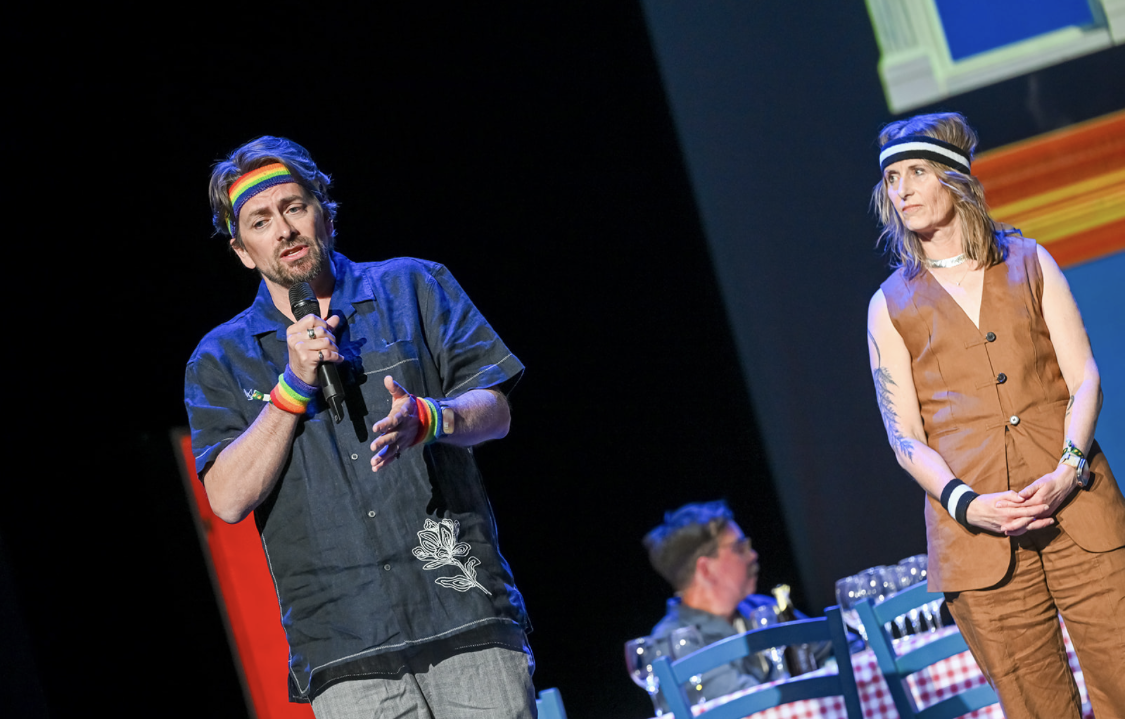
We didn't go in as democracy experts. We went into this with our expertise in AI, decision-making, and what AI does to collective intelligence—and to collective stupidity. The birthplace of democracy felt like the right place to talk about AI and democracy because so much is rhyming right now. The collapse of accountability. The hubris, acceleration, and concentration of power that democracy was built to keep in check. We need democratic push back more than ever and yet it's in retreat.
The most important thinker on this in our view is Geoff Mulgan, and I was thrilled when he said yes to our 2025 Summit. At the Summit he asked us to design a new institution. A brainstorm in ten minutes with a room full of people whose aspiration was thinking about how societies organize themselves. And we couldn't produce one institutional form that didn't already exist.
We deserve innovation in our institutions. Tech gets all the imagination and governance gets none.
In Athens, Mulgan ran another quick trick. He asked: "Who said in 2016 that radiologists would be obsolete?" Everyone remembered Hinton. Then his follow up: "Who correctly predicted what LLMs would do to the world?" Silence. A rapid and unforgettable demonstration that the people building artificial intelligence are often quite confused about human intelligence and misinterpret it badly. Geoff was forceful about it. He said the most intelligent technology ever invented is being rolled out in the least intelligent way. I put that comment on social and, wowza, did I get trolled.
Then there's our reflections on hope. I did not know Rachel Goslins, but I do now. She hosted the final session on stage. She said something in line with Geoff but with a different emotional tone—that the institutions meant to help us hope have failed us. Hope used to be infrastructural, but now it isn't. We are left to manufacture it privately and most of us can't.
Her metaphor was amblyopia. You don't fix a lazy eye by exercising it gently. The doctor patches the good eye and forces the weak one to work. Hope and imagination are our lazy eye. The strong eye has been doing all the seeing.
She proved it on stage in the ultimate "show-not-tell" exercise. One Gen Z and two Gen X talking about hope. The Gen Z said his generation has no working memory of it, especially in Greece. He said they have no idea how to "do" hope and they need older generations to show them how. Then the two Gen X panelists—ostensibly there to talk hopefully—just listed catastrophes. This was so much harder to watch than either of us expected, especially when one of the "hopeful" Gen Xers said something along the lines of: you have no idea how bad this is going to get.
Are we really that fucked? And why is it so damn hard to be hopeful, and even harder to turn hope into something tangible? Why is it that our minds and voices turn always to the worst?
Hope requires uncertainty. You can't hope for what's already settled. The muscle that holds not-knowing is the muscle that imagines something better. Predictions close the future and that's what makes them corrosive, even when they're right. Reading predictions lets us feel like we're thinking when we're being thought at. Today's predictions from many AI leaders—and increasingly corporate leaders too—are pitched as certainty. 50% unemployment of grads by 2030. 30% unemployment of everyone else. AGI by 2030 (or maybe 2027). Agents that can run for a month by mid-next year.
The numbers feel so much more authoritative than ideas for new value structures. But this is yet another form of optimization, this time one that optimizes for raising money. Another choice quote from the marathon: "AGI is great for fund raising."
And the result is that we treat optimization as serious and imagination as soft. So we've lost more than we realized. We have to rebuild the lazy eye.
The House does this to us every time. The spirit we love from the House: aspiration, inspiration, mind-blowing creativity, and community. And how we will craft our own arc for the Artificiality Summit 2026—our mix of hope, imagination and intellectual depth into Bend this October, where the theme is Unknowing.
Thanks again to our Artificiality community that came to Athens too: Tess Posner, Larry Irving, Sean White, Beatriz Paniego Béjar, Geoff Mulgan, Julia Pahina.
And our new friends: Monique van Dusseldorp, Zoe Scaman, Claudia Chwalisz, Kristoffer Tjalve, Grant Toups, Lisa Witter, Elaine Kasket.
Artificiality Summit 2026
Join us October 22-24, 2026 in Bend, Oregon for 2.5 days with a fantastic group of speakers—academics, authors, designers, investors, photographers, and more.
We'll explore the theme of Unknowing—not ignorance, but a necessary release of inherited assumptions. We don’t yet know what AI will become, and we don’t yet know what we will become in relationship to it.
Unknowing is the space between—the place where neither side is fixed, and something new can emerge.
If you're worried about agents taking over the world—and your job—Demis Hassabis said something recently that seems overdue. He described watching young developers run numerous AI agents simultaneously, producing enormous volumes of functional code. And across all of that output, he had yet to see a single new product emerge.
Demis highlights that there's a gap—between production at unprecedented scale and value at zero—and it's not a quality problem or a skills problem but an early sign that the relationship between output and value has structurally changed.
I think we need to take a closer look at this and try to understand what might be happening to the system AI is entering.
The AI future has two stories: abundance or catastrophe. Both assume the same thing—that exponential capability translates proportionally into the world. It never has. Complex systems under exponential pressure don't keep going up. They reorganize. And what they reorganize around is always a new scarcity.
AI makes cognitive production nearly free. So the scarce thing shifts—from output to verification. From the ability to produce to the ability to know whether what you produced is actually right for this specific situation. That changes what we should invest in, how we develop talent, and what a vision for the future actually looks like. This is my attempt at one.
Read it here.
By Helen
Consciousness is the thing right now. If you've noticed that and want one book on it—written by a human, for humans, by one of the best nonfiction writers working —this is it. Pollan spent six years on this. He's skeptical, curious, and covers the science nicely without going too into the weeds. There is so much online about this book already that I don't need to say much. I enjoyed it and if I was reading it again I would go for the audiobook as he reads it himself and I do like his voice.
And you can read where I am on consciousness here.
Helen talks with Pedro Serôdio about AI and jobs - specifically what are we seeing in the data? We talk about recent evidence from the UK labour market which reveals that there is currently no sign that AI has replaced jobs at scale.
Instead of widespread automation, the data shows that AI is being used quite narrowly for specific tasks, and employment in highly exposed occupations has actually continued to grow.
But there's a lot more going on - with the big question: what isn't in the data, what do we know from recent Fed work and how should we think about fundamentals of AI and labour economics. This is a terrific conversation with a few apologies for some internet glitches.
Report we talked about here.
Our video production is up, especially short videos. Follow us on your favorite channels—and please like, share, and repost to help us spread the word.
AI is changing how you think. Get the ideas and research to keep you the author of your own mind.